The Fraud Chain Runs Through the Session, and Liability Is Moving There Too
Over the past six weeks, ThreatMark’s fraud analysts have followed one fraud chain from three directions: the phishing campaigns that open it, the call center tooling that keeps a victim on script, and the AI that is making both cheaper to run. The cases came from different markets and relied on different tools, but each one ran through in the same place: a banking session in which the credentials were valid, authentication passed, and the money moved anyway.
We timed the series around International Fraud Awareness Week, which the Association of Certified Fraud Examiners (ACFE) holds every November to promote anti-fraud awareness and education, and which runs this year from 15 to 21 November. As the week draws to a close, that shared point is worth looking at directly, because over the past year courts and legislators in Europe have been clarifying who pays when it goes wrong.
The recent CJEU phishing ruling and what it means for banks
The most direct of those decisions came on 15 October, when the Court of Justice of the European Union ruled in Case C-70/25 that a bank cannot refuse the immediate refund of an unauthorized payment on the grounds that the customer was grossly negligent. The case began with a Polish bank customer who was selling an item on an online sales platform, followed a phishing link, and entered her banking credentials on a fake site, after which the attacker used them to move money out of her account. Her bank refused the refund because she had failed to protect her credentials, and the court held that this was not a valid reason to withhold it. Because the judgment interprets the Payment Services Directive (PSD2), its effect is not limited to Poland and applies to banks across the EU.
The decision separates two questions that banks have often treated as one. Under PSD2, the refund of an unauthorized payment is owed immediately, and in any event by the end of the following business day, with the only exception being a reasonable suspicion of fraud by the customer, reported in writing to the national authority. Whether the customer ultimately bears the loss is a separate question decided afterward, and a bank that believes the customer was grossly negligent can pursue recovery only after the refund has been made, as Advocate General Rantos had proposed in his opinion on the case in March. National courts are moving in a similar direction: in June, the Belgian Supreme Court set out its first explicit definition of gross negligence in a smishing case, describing it as a qualified breach of the duty of care that has to be assessed against all the circumstances of the case.
For banks, the practical effect is that a phishing loss now lands on the balance sheet first and is argued about later, which shifts the weight onto the evidence a bank can produce after the fact. The ruling’s scope matters as much as its outcome, though, because it covers unauthorized payments only, and the scams in which a deceived customer approves the transfer fall outside it. Both kinds of fraud featured in our series.
Three stages of the same fraud chain
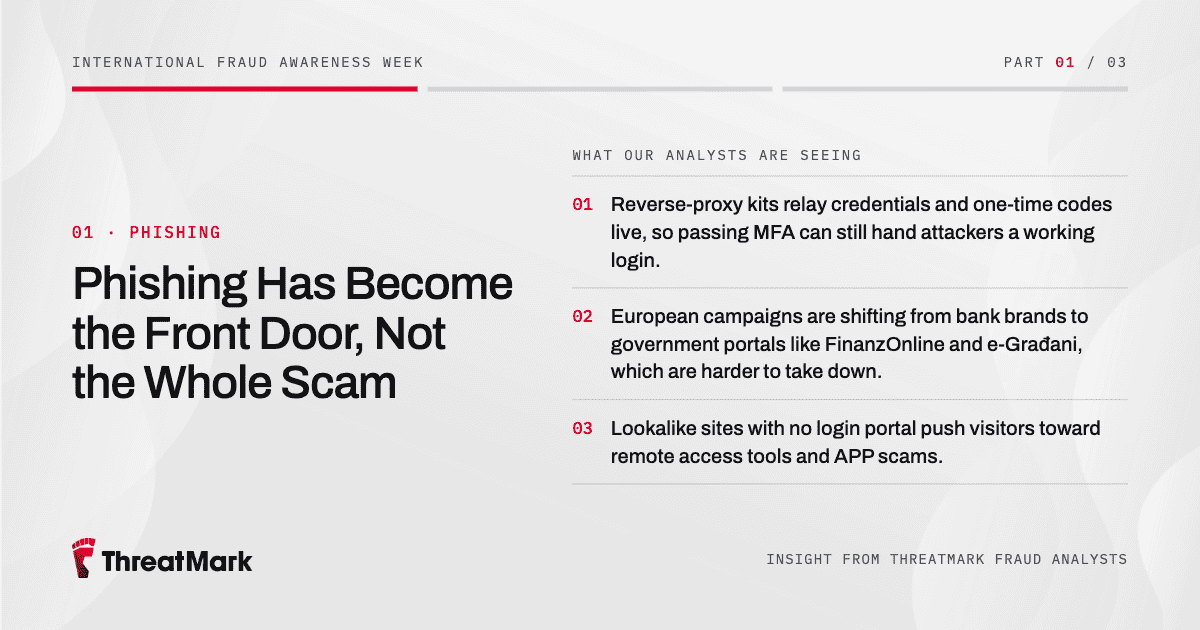
Phishing is often treated as a familiar, well-understood threat, and its losses are usually counted on their own, but its real cost shows up later in the account takeover and authorized push payment cases it makes possible. A bank that measures phishing by phishing losses alone is looking at the smallest part of the problem. Our phishing research, published as Phishing Has Become the Front Door, Not the Whole Scam, showed how reverse-proxy kits capture an authenticated session along with the one-time code, and how campaigns in Europe have shifted toward tax and citizen-service portals that no brand owner is racing to take down, while the stolen credentials can resurface months later as account takeover.
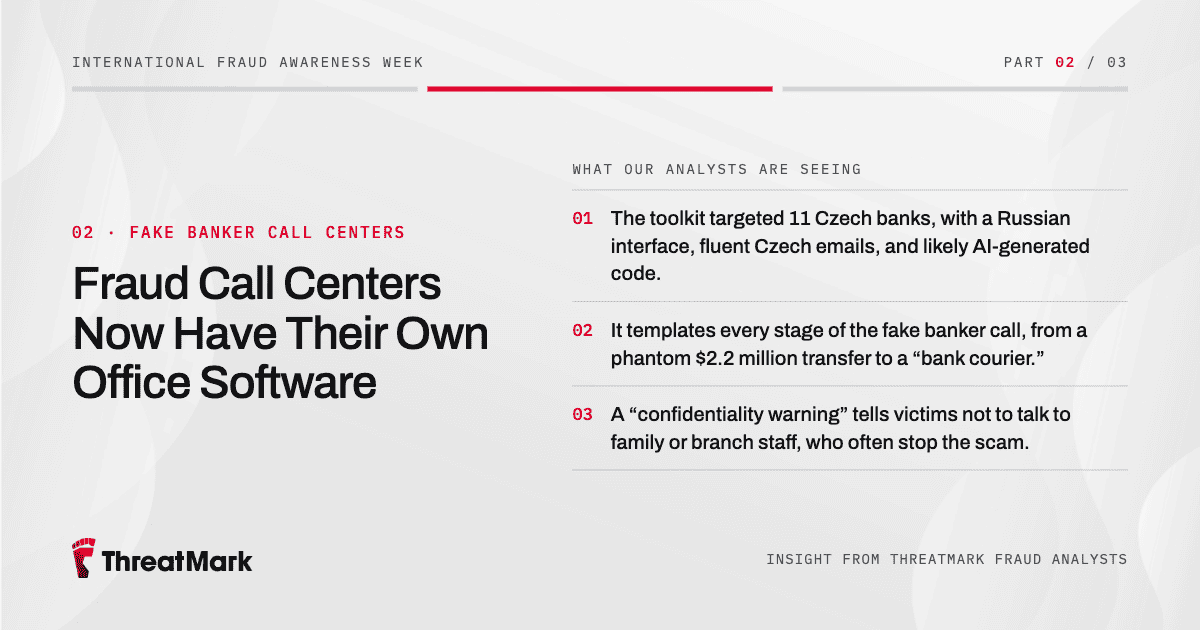
The fake banker scam deserves the same attention because it is built to remove the human checkpoints that usually stop it, which leaves the bank’s own digital channels as one of the few places the manipulation can still be seen. Our call center research, Fraud Call Centers Now Have Their Own Office Software, followed the chain into the fake banker call center, where a web-based toolkit generates bank-style emails and documents mid-call. One of its templates is a confidentiality warning written to keep the victim away from the teller and the family member most likely to stop the scam.
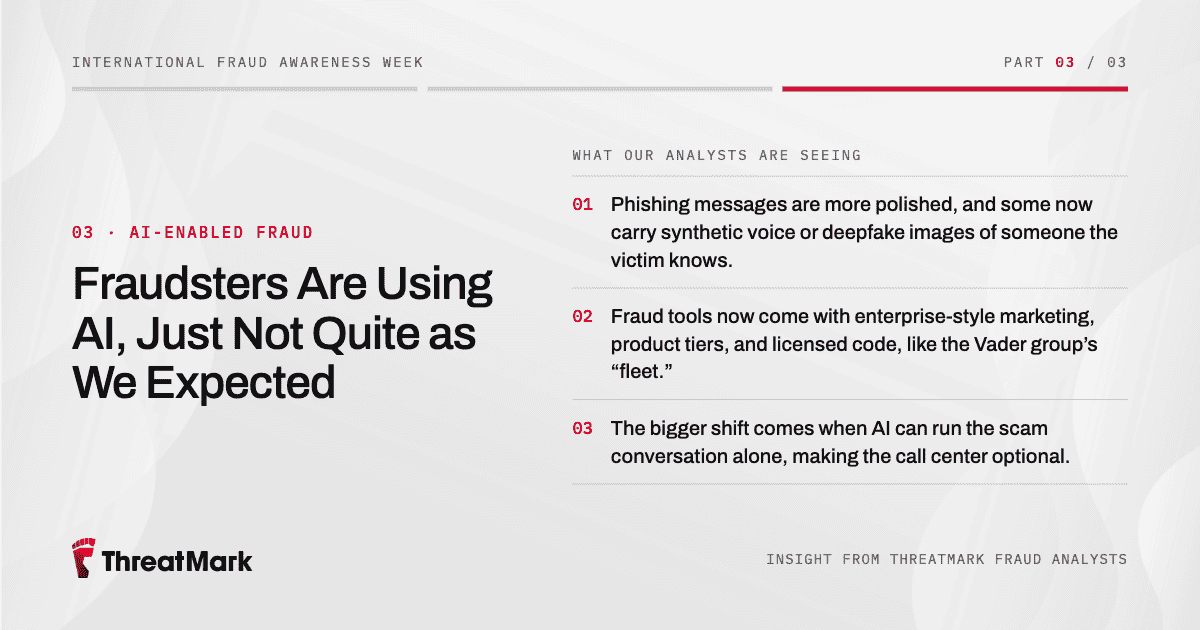
AI is a topic where the gap between headlines and practice is wide. Coverage tends to focus on deepfaked executives and cloned voices, while the change banks are more likely to see is a steady drop in the cost, skill, and language barriers behind the scams they already deal with. Our third and final research piece, Fraudsters Are Using AI, Just Not Quite as We Expected, looked at how fraudsters are using AI less to run whole operations than to polish selected parts of them, from fluent phishing copy to branded tool catalogs like the Vader group’s “fleet.” It closed by arguing that the bigger shift will come when AI can hold the scam conversation on its own.
Read side by side, the three articles describe a fraud chain in which most controls upstream of the session can be satisfied legitimately or bypassed in advance. That leaves the session itself as the place where the bank still has a chance to tell its customer apart from the fraud. It is also becoming the place where the question of who absorbs the loss gets settled, and two recent developments in Europe show that question moving toward the bank in two of the scenarios.
Liability is following the same chain
The ruling maps directly onto our phishing research. Its facts follow the same pattern, with credentials harvested on a fake site and then used to move money from the customer’s account, and its consequence lands where that research placed the real cost of phishing: in the account takeover that follows, which the bank now refunds first and can recover only by proving gross negligence. That is a harder case to make when reverse-proxy kits relay credentials and one-time codes in real time, because the authentication log looks the same whether the customer or the attacker was on the other end.
The second development covers the ground the ruling leaves open, because authorized fraud falls outside the judgment. In November 2025, EU negotiators reached a provisional political agreement on the Payment Services Regulation and PSD3, which introduces mandatory reimbursement for victims of impersonation fraud. The agreed text narrows that right to cases where the fraudster impersonates the victim’s own payment service provider or its staff. That covers the payment side of the fake banker scam from our call center research, where the victim is talked into moving money on the instruction of someone posing as the bank, which means European banks can expect to reimburse that scenario once the regulation applies. The cash withdrawals and courier handovers the toolkit also scripts would sit outside it.
Why this matters for financial institutions
Together, these changes move the cost of the fraud chain onto banks at the point where their traditional controls see the least. In the phished session the credentials are correct and the one-time code was entered. In the coached session the device is the customer’s own and the payment is authorized. Transaction rules and MFA have nothing to object to in either case, yet the bank is now expected to refund the first and, increasingly, the second.
That leaves banks with two jobs. The first is to stop the fraud before the payment executes, which means reading the session for the signals that do differ. After a phishing campaign, that can be a login whose device and behavior don’t match the customer’s history. When a genuine customer is being talked through a transfer, it shows up as hesitation, dictated input, and remote-access activity. The second job is to hold the evidence when prevention fails. A bank that wants to argue gross negligence after the refund, or to show that its fraud controls were adequate under the new liability rules, needs a record of what happened inside the session, not just a log showing that authentication succeeded.
The upstream work still counts. Taking down phishing sites early, including the government-impersonation domains nobody reports on a bank’s behalf, reduces the volume of stolen credentials in circulation. Intelligence on the mule accounts receiving the funds gives the bank a second view of the same payment. Each of those controls narrows the chain, but the cases in this series, and the legal changes running alongside them, suggest that the session is where banks will increasingly be asked to show what they saw and when they saw it.
International Fraud Awareness Week is a useful moment to test where that evidence sits today. A practical place to start is a recent account takeover or impersonation case: check what the session record would show if the customer disputed the refund, because that record now matters to the bank’s liability position as much as to its fraud defense.