
What Good Scam Education Looks Like
Scam education is one of the banking industry's most widely used fraud prevention strategies. The idea is simple: if scams succeed by manipulating people into acting against their own interests, helping customers recognize those tactics should reduce fraud. But does it?
That question is no longer just academic as regulators are placing growing emphasis on customer education. In Europe, the proposed Payment Services Regulation (PSR) strengthens expectations around informing customers about fraud risks. Globally, the OECD's 2026 review calls on policymakers and financial institutions alike to improve digital financial literacy and strengthen public awareness of scams.
As those expectations grow, banks face a more fundamental question: what does effective scam education actually look like?
Analysis: Inside Three Influential Scam Awareness Campaigns
Let's look at three of the most famous scam and fraud awareness campaigns to date—where they succeed, where they fall short, and why some awareness efforts change behavior while others merely capture attention for a while.
Take Five (To Stop Fraud)
Led by: UK Finance
Launched: 2016
Strategy: Take Five is a national, industry-wide initiative built around a common brand and set of messages that any financial institution or organization can adopt. The entire campaign revolves around three words: Stop. Challenge. Protect.
That simplicity is intentional. Rather than teaching people about dozens of scam types, Take Five aims to create a single mental habit that people can recall under stress: stop and think. Ask yourself, could it be fake? If you think you've been scammed, contact your bank and report it immediately.
The repeated, easy-to-remember message is more likely to stick—and, importantly, it applies to almost any scam scenario. Take Five reinforces the same message across a wide range of customer touchpoints, from digital channels to branch and community outreach.
Impact: The campaign achieved national reach and widespread industry adoption, with thousands of organizations using its materials. In 2023, nearly 7 in 10 respondents recognized some element of the Take Five campaign or its messaging when prompted. However, there is little evidence this awareness is linked to measurable changes in customer behavior or fraud losses.
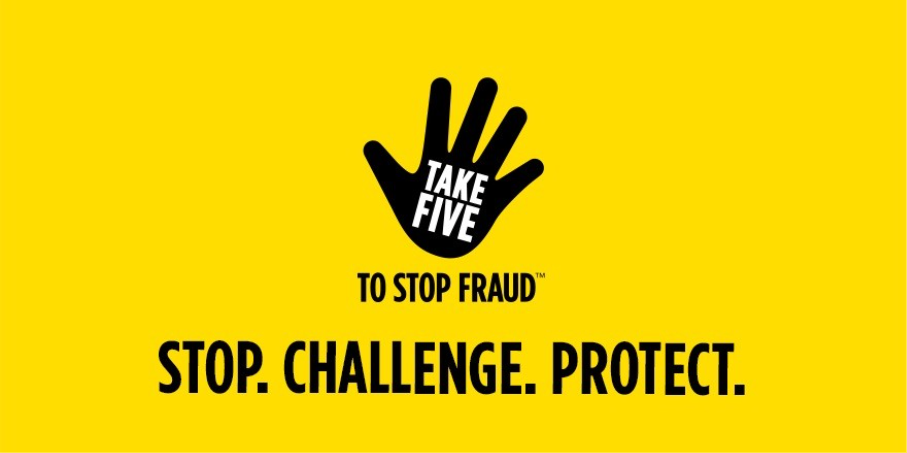
Image @ UK Finance
Banks Never Ask That
Led by: American Bankers Association (ABA)
Launched: 2020
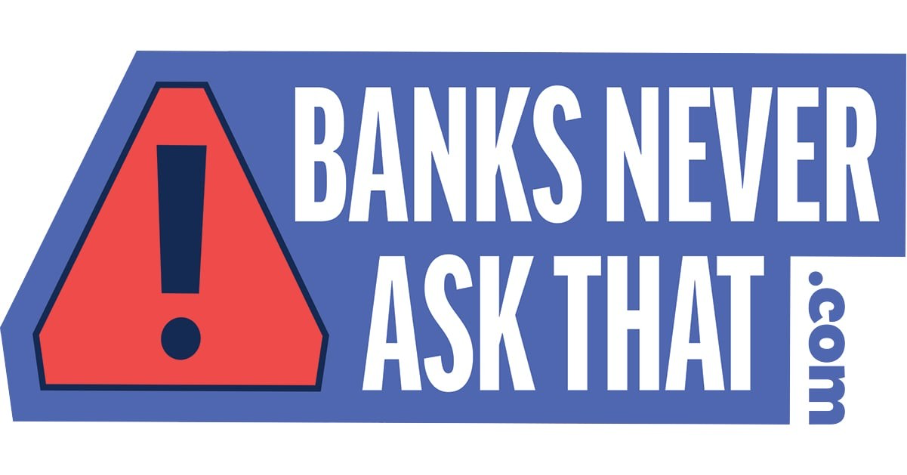
Strategy: The core of Banks Never Ask That campaign is built around a simple premise: banks never ask for your password, PIN, one-time code, or Social Security number. This shifts the question from "How do I recognize a scam?" to "What would a legitimate bank never do?"
The campaign is distinctive for its exaggerated scam scenarios and absurd situations. The humor makes the message more memorable while lowering resistance to educational content.
Like the Take Five campaign, Banks Never Ask That relies on a simple, rule-based message that can be applied across a wide range of fraud scenarios. ABA also designed the campaign to be easily adopted by individual banks through a ready-made communications toolkit, helping the message scale across institutions and customer touchpoints.
Impact: Beyond traditional metrics focused on scale and reach (2,500+ participating banks and 21+ million impressions as of 2024), ABA also highlighted a case study from Kish Bank in Pennsylvania. The bank integrated Banks Never Ask That into a broader fraud-awareness program, with notable results:
-
94% decline in customer fraud losses from Q4 2023 to Q1 2024.
-
Staff reported that customers asked more questions and flagged suspicious activity before losses occurred.
This particular success stemmed from the fact that Kish Bank combined Banks Never Ask That with other initiatives, including Safe Banking for Seniors, as part of a broader fraud-awareness strategy. The case highlights an important lesson: scam education has the greatest impact when it forms part of a larger, strategic program.
Example from the American Bankers Association's #BanksNeverAskThat campaign. Image © American Bankers Association.
Daisy vs. Scammers
Led by: Virgin Media O2
Launched: 2024
Strategy: O2 took a different approach to scam education. Instead of teaching people what to do, it created Daisy, an AI-powered "grandmother" designed to waste scammers' time.
Daisy posed as the ideal victim: elderly, friendly, trusting, and slightly confused, leading scammers to believe they had found an easy target. Instead, they found themselves trapped in long, meandering conversations that continued until frustration finally made them hang up.
Unlike Take Five or Banks Never Ask That, Daisy didn't rely on a memorable call to action. Instead, it used humor, curiosity, and storytelling to make fraud prevention engaging. By exposing common scam tactics through entertaining content, the campaign encouraged audiences to pay attention, share the message, and become more aware of how scammers operate. The result was extensive media coverage that helped the campaign reach far beyond traditional fraud-awareness audiences.
Impact: Daisy generated extensive publicity, including more than 2,000 pieces of global media coverage with around 2 billion impressions. More important, however, was its fraud-prevention impact. The campaign encouraged consumers to report scam numbers, increasing awareness of O2's scam-reporting number, 7726, from 18% to 26%. Reports submitted to 7726 increased by 8% month over month during the campaign.
Daisy also received more than 1,000 real scam calls and occupied hundreds of hours of scammers' time. While this is unlikely to have had a “disruptive” effect on scam activity overall, it reinforced the campaign's message.
What These Campaigns Get Right
Take Five, Banks Never Ask That, and Daisy are very different campaigns—yet their success is built on a surprisingly consistent set of principles. Institutions looking to strengthen their own scam education programs should start with these four lessons.
1. Measure behavior, not reach
Good scam awareness programs don't judge success by reach, impressions, or media coverage alone. They measure whether customers actually behave differently—through outcomes such as more scam reports, earlier reporting of suspicious activity, fewer fraud losses, or a decline in successful scams.
That's where many campaigns stumble. A message can reach millions of people and still fail to change behavior. Without measuring behavioral outcomes, banks know how many people saw the message—but not whether it made a difference.
2. Don't teach fraud. Teach decisions
Good scam education doesn't rely on long checklists or detailed explanations of fraud tactics. All three campaigns were built around simple, memorable messages. Their goal wasn't to turn customers into fraud experts, but to help them remember one key action or rule they could apply under pressure.
That's where many campaigns lose impact. They try to communicate too much at once. Customers may understand the information while reading it, but struggle to recall it when a scammer puts them under pressure.
3. Give people a reason to pay attention
The best scam awareness campaigns do more than educate—they engage. Take Five relies on directness, Banks Never Ask That uses humor and absurdity, and Daisy turns fraud prevention into a story people actually want to watch and share.
Campaigns built around information alone often struggle to stand out. If people don't remember the message, they're unlikely to act on it when it matters most.
4. Reach people at the right moment — repeatedly
All three campaigns relied on broad distribution and repeated exposure across multiple channels. Research suggests that timing matters as much as content, with customers benefiting from repeated, contextual reminders rather than one-off messages. The lesson? Scam education is most effective when it forms part of a broader strategy that consistently reinforces the same behaviors.
If your fraud prevention relies on a single annual awareness campaign, it may generate reach—but little else.
The Limits of Scam Education
Take Five, Banks Never Ask That, and Daisy represent some of the best scam awareness campaigns in the world. Yet even they reveal an important truth: education alone can only go so far.
-
Take Five doesn't directly measure whether it changes customer behavior. Its effectiveness therefore rests largely on a reasonable (but unproven) assumption: that people who remember the campaign are more likely to apply its advice when confronted with a scam.
-
Banks Never Ask That is less applicable to scams where the bank is never part of the story, such as the increasingly common investment and romance scams. Although newer versions address social engineering more broadly, the campaign's original message is relatively easy for scammers to circumvent.
-
Daisy vs. Scammers is an outstanding awareness and PR campaign, but its behavioral call to action is less central than in the other two examples. Encouraging people to report scams is valuable, but reporting a scam is not the same as preventing one.
That's the inherent limitation of mass-awareness campaigns. However well executed they are, their impact is ultimately constrained by the nature of mass communication. For example, one study published in the European Journal on Criminal Policy and Research examined the impact of mass-awareness campaigns on financial fraud and found no measurable reduction in fraud victimization.
Behavioral Intelligence: When Knowing Better Isn't Enough
Nearly 60% of US adults say they receive suspected scam attempts every day. At some point, the question stops being whether customers can recognize every scam. The more important question becomes: what happens when they can't? That's why banks increasingly need a way to recognize when a customer is acting under manipulation.
So how can banks recognize when a customer has fallen for a scam?
The answer lies in behavior. Customers who are being manipulated don't behave as they normally would. Once they enter their banking session, they begin to show signs of being manipulated: hesitation, unusual navigation patterns, repeated copy-paste, screen sharing, active phone calls, unusual transactions, and other session anomalies.
These behavioral changes don't go unnoticed. They can be observed, analyzed, and understood in real time throughout the customer journey. That's where behavioral intelligence changes the game, allowing fraud teams to identify suspicious sessions and intervene before money leaves the account.
In other words, behavioral intelligence becomes the safety net for the moments when the first line of defense—education and awareness—has already been breached. And as scams become more sophisticated and more frequent, those moments are becoming harder to avoid.
Layers, not Competitors
The best scam awareness campaigns draw on the principles of human psychology to help customers recognize and resist manipulation. Behavioral intelligence builds on that same understanding of human behavior—but from a different perspective. Instead of helping customers recognize manipulation, it helps banks recognize when manipulation has already taken hold.
That's why education and behavioral intelligence are not competitors. They're complementary layers of defense. The strongest scam prevention strategies combine both: awareness to reduce susceptibility, and behavioral intelligence to protect customers when manipulation succeeds.
Discover how ThreatMark helps banks identify manipulation before losses occur.