

Build vs Buy: The Myths and Realities Behind Investing in Fraud Prevention
As fraud accelerates faster than prevention budgets can keep up, the build-vs-buy decision has never been more critical.
Financial institutions will spend $39.1 billion on fraud detection and prevention before 2030, according to Juniper Research. These rising investments reflect the growing strain on fraud defenses as threats continue to expand.
This pressure raises a familiar dilemma: should institutions build their own fraud prevention systems, or rely on specialist vendors? How do the costs compare? What about long-term effectiveness? And where do you even start?
For financial institutions facing these questions, this article distills practical insights from the industry. It examines the pros and cons of both approaches and shows why fraud prevention is a continuous journey, not a fixed choice.
Start with Why
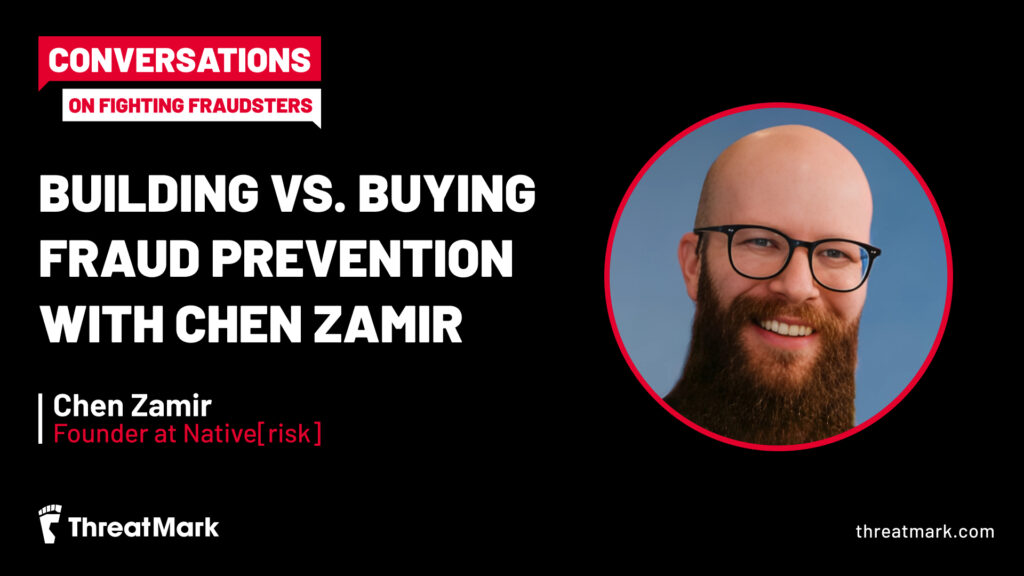
As Chen Zamir explained on Behind Enemy Lines, financial institutions should begin with their strategic goals and long-term vision. Fraud prevention is more of a chess game than a chase. You have to anticipate the opponent’s next move and design defenses accordingly.
In other words, the build-vs-buy decision shouldn’t hinge on “can we code this in six months,” but on whether the choice aligns with long-term strategic fit in a constantly moving landscape.
Still, misconceptions about what building vs buying really entails are common, and they can steer banks and credit unions off course. Here are the ones seen most often, along with the realities behind them.
Myth 1: “Any strong engineering team can build fraud prevention”
Many institutions have excellent engineering talent—people they’ve invested in heavily—and it’s natural to assume that leveraging internal resources to build an in-house system is the logical next step. In theory, this approach can deliver tighter strategic alignment and potentially even better performance. That part is true.
However, here are the facts to consider:
- Fraud prevention systems require deep fraud domain expertise, not just engineering skill. Engineers can build features, but fraud prevention is built on understanding attacker behavior, threat vectors, payment flows, and how fraud manifests in real user journeys. Without this domain insight, teams often solve the wrong problems or fail to detect emerging ones entirely.
- Real-time detection demands highly specialized system design. Fraud signals must be collected, scored, and acted on within milliseconds, without disrupting legitimate users. Designing infrastructure that is fast, stable, and accurate under constant load is far more complex than a typical product build.
- Human processes are as important as the technical capabilities. Fraud systems don’t operate in isolation. They feed analysts, investigators, operations teams, and customer support. If an institution lacks mature decision-making processes or the expertise to interpret risk signals, even the best in-house models won’t deliver the required protection.
Practically speaking, you might have strong engineers, but do you genuinely possess deep internal fraud expertise? The knowledge of attacker tactics, behavioral patterns, calibration, and tuning? Are your engineers experienced in designing real-time detection systems? And do you have verified internal workflows and human processes to support them?
It’s important to remember that fraud management always ends with a human making a decision. The tools you build must serve (and ideally strengthen) that decision-making process.
As Chen Zamir puts it: “If you don’t have the team that makes these decisions… and you’re not even aware which decisions you need to take and how… then how do you know what to build?”
Myth 2: “Building in-house is more cost-effective”
A common belief is that building in-house is cheaper. The logic usually goes like this: institutions already have engineering teams, they know their systems and risk profile better than anyone else, and they assume they can build a leaner solution, focused only on the capabilities they truly need, without paying for a full vendor platform. This creates an impression of tighter control over scope and lower long-term cost.
On the surface, this sounds reasonable. However, here are the facts:
- Maintenance costs are up to 30–40% of the initial build cost every year. Fraud systems must be monitored, recalibrated, updated and adapted continuously. Engineering time, rules lifecycle management, infrastructure tuning, incident response, and compliance updates all add up, quickly turning the “one-off project” into a permanent cost center.
- Every 2–3 years, you will effectively re-invest the entire original project cost. The math is straightforward: within three years, you’ve spent the full build cost again just to keep the system running. This doesn’t include new capabilities, improved detection methods, or architectural upgrades.
- Vendor solutions often cost less overall and include continuous updates and upgrades. Specialist vendors amortize development across many clients, which lowers cost per institution. More importantly, updates, threat-intelligence improvements, model refreshes, and new detection capabilities are part of the product, not a new budget request.
Put simply, committing to an in-house build means committing to a continual investment. Fraud prevention systems are never “finished,” because fraud tactics are never fixed. You have a live adversary that works tirelessly against you—so your detection must stay just as live and adaptable.
This is why maintenance and evolution end up far more expensive than most teams anticipate.
Myth 3: “Our machine learning models are better because they use our data”
There is a common belief that having unique, proprietary data automatically leads to better outcomes, and that machine learning (ML) models trained solely on this data will outperform anything a vendor can offer. In some areas, that can be true. But in fraud prevention, the reality is more complex.
Here are the facts:
- Your data matters, but it’s not the whole picture. Vendor models are trained on far broader datasets, giving them earlier visibility into emerging behaviors and allowing them to adapt to new fraud patterns more quickly.
- ML expertise alone isn’t enough. Fraud ML requires deep domain knowledge, constant tuning, and operational insight. Most in-house ML teams don’t focus exclusively on fraud, and they also introduce key-person risk: losing even one lead engineer can set internal development back significantly.
- Custom rules work only if you measure their accuracy. Rules degrade over time, and without disciplined monitoring, they quickly become outdated or even counterproductive.
Your own data is crucial, but it can also become a trap. One of the most common pitfalls is assuming your dataset represents the whole world. It doesn’t. Fraud patterns emerge elsewhere first, evolve elsewhere first, and vendors often see them long before an individual institution does. Thinking only within the boundaries of your own data means missing the bigger picture.
Is It Always Better to Buy?
While building is rarely the easiest or cheapest option, often leaving institutions investing far beyond the original plan with detection that never fully matures, buying is not a magic shortcut either. It comes with its own advantages and its own considerations. Understanding both sides is key to making the right long-term decision.
Why and When to Buy
- You need effective protection quickly. Vendor platforms deliver proven detection in weeks, not years.
- You don’t have deep fraud-domain expertise in-house. Fraud ML, threat research, and model tuning require specialized knowledge that most engineering teams don’t have.
- You want continuous updates without continuous reinvestment. Vendors ship new models, recalibration, and emerging scam coverage as part of the product.
- You need predictable, stable costs. Subscription models are easier to forecast than multi-year builds with escalating maintenance.
- You want internal teams focused on core priorities. Buying lets institutions strengthen fraud defenses without diverting resources from their main product roadmap.
Buying also comes with considerations. No vendor will ever understand your business, KPIs, customer behavior, and risk appetite as deeply as your internal teams do, and even the most flexible platform cannot be tailored one-to-one to every institution’s exact needs. These limitations don’t diminish the value of buying. Rather, they highlight that vendor solutions work best when paired with strong internal ownership and a clear fraud strategy.
Build vs Buy: Decision Checklist
1. Strategy
- Do we have a clear fraud strategy, not just tactical fixes?
- Do we know which user journeys, attack vectors, and leakage points matter most?
→ If not, don’t build.
2. Total Cost
- Have we included 30–40% yearly maintenance?
- Are we prepared to reinvest the full build cost every 2–3 years?
- Will building actually be cheaper than a vendor over the full lifecycle?
→ If the math only includes the initial build, it’s wrong.
3. Expertise
- Do we have fraud domain experts, not just engineers?
- Do we have analysts and operators who will use and tune the system?
- Can the system operate effectively if there is turnover in the team that built it?
→ If expertise is thin or centralized, building is a liability.
4. Performance
- Can we outperform vendor models trained on broader fraud patterns?
- Do we have a plan to measure accuracy, drift, and rule degradation?
- Can we maintain real-time quality as fraud changes?
→ If you can’t confidently answer yes, buying is safer.
5. Time-to-Value
- Can we wait 12–24 months before seeing results?
- Can we operate safely during the build phase?
→ If speed matters, buy first.
Choosing the Middle Route: Hybrid Approaches to Build vs Buy
There’s also one more crucial question: can a vendor platform be combined with your own logic or data? In most cases, the answer leads to a hybrid approach.
Most financial institutions already have parts of a working fraud prevention setup: internal rules, models, case management, or monitoring workflows. What they often lack are specific capabilities a vendor can provide, or support for emerging fraud vectors that are difficult to address in-house. A hybrid path allows institutions to keep what works and strengthen what doesn’t.
A common example is a bank that has strong defenses against unauthorized fraud (e.g., solid controls around credential misuse, device risk, and transactional anomalies) but still struggles with emerging threats.
In these cases, a hybrid approach works best: the institution keeps the parts that already perform well and brings in a vendor to cover the gaps that require specialized capabilities.
How ThreatMark Can Support a Buy or Hybrid Approach
ThreatMark’s fraud disruption model is built to slot into different maturity levels and operating models. Institutions that need to buy can adopt ready-to-use capabilities, such as behavioral intelligence or early-stage phishing site monitoring that provide immediate coverage where internal systems are weakest.
For institutions already building in-house, ThreatMark operates as a complementary layer, extending detection into areas that are difficult to cover internally.
Finding the Right Balance
Build vs buy is a spectrum, not a binary choice. Early on, institutions typically rely more on vendor capabilities; with greater maturity, some functions naturally shift in-house. But a degree of outsourcing almost always remains. What matters is choosing the mix that supports your strategy and strengthens your defenses across the entire fraud lifecycle.
Talk to a Fraud Fighter
Related Articles
-
 March 23, 2026
Ireland’s Surge in E Money Fraud Signals a New Digital Battleground
Ireland has just come through one of its strongest periods of digital payment growth.
E-commerce contactless transactions, including...
March 23, 2026
Ireland’s Surge in E Money Fraud Signals a New Digital Battleground
Ireland has just come through one of its strongest periods of digital payment growth.
E-commerce contactless transactions, including...
-
 February 11, 2026
Gold Medal Scams and the Milan Cortina Games
With over 3 billion global viewers and 2 million attendees expected, the 2026 Milan Cortina Winter Olympics concentrate...
February 11, 2026
Gold Medal Scams and the Milan Cortina Games
With over 3 billion global viewers and 2 million attendees expected, the 2026 Milan Cortina Winter Olympics concentrate...
-
 January 26, 2026
Navigating Costa Rica’s Evolving Fraud Protection Framework
With stricter fraud protection requirements and an evolving liability debate, Costa Rican banks are under growing pressure to...
January 26, 2026
Navigating Costa Rica’s Evolving Fraud Protection Framework
With stricter fraud protection requirements and an evolving liability debate, Costa Rican banks are under growing pressure to...