

The 2026 SPARK Matrix Is Out. Here’s What Every Fraud Team Should Know
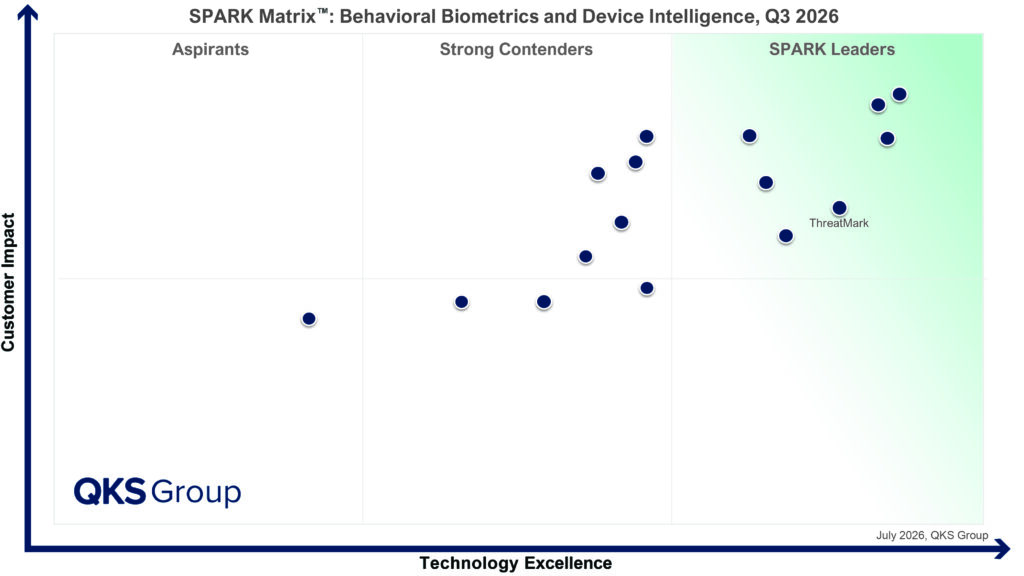
QKS has published its SPARK Matrix™: Behavioral Biometrics and Device Intelligence Solutions—and the results are worth a closer look. Beyond recognizing ThreatMark as one of the market Leaders, the report offers a useful snapshot of the capabilities shaping today’s behavioral biometrics and device intelligence market.
Five Trends Reshaping the Fraud Prevention Market
The behavioral biometrics and device intelligence market has evolved rapidly in recent years. New technologies, changing customer expectations, and increasingly sophisticated fraud have brought a growing number of vendors into the space. Amid all this change, however, a clear pattern is emerging.
Fraud prevention is no longer focused solely on proving who the customer is. Increasingly, the challenge is understanding what the customer is doing, why they are doing it, and whether their behavior signals risk. QKS recognized ThreatMark as a Leader because our approach aligns with that shift.
The report points to five trends that are reshaping fraud prevention—and, importantly, raising the bar for what financial institutions should expect from their detection platforms.
1. Identity Is No Longer Enough
For years, fraud prevention focused on answering a relatively straightforward question: “Is this really the customer?” The wave of manipulation-based scams and APP fraud has, however, exposed the limits of traditional identity-based controls.
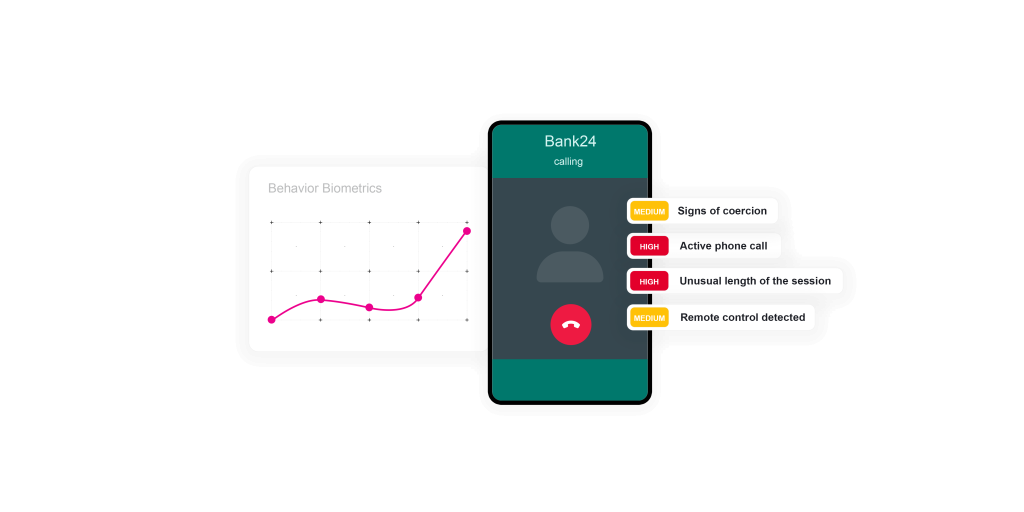
With scenarios where a genuine, authenticated customer makes a fraudulent payment from a trusted device becoming a major headache for fraud teams, leading behavioral biometrics and device intelligence platforms are shifting their focus from verifying identity alone to understanding intent and context. Instead of asking only “Is this the legitimate user?”, they are increasingly asking “Does this behavior suggest coercion, manipulation, scam risk, or mule activity?”
Leading vendors are responding by continuously analyzing behavior throughout the session to distinguish normal customer activity from signs of coercion, manipulation, or fraud. The objective is no longer just to confirm identity, but to assess intent before a payment is made and losses occur.
2. Trusting the Device, Not Just Recognizing It
For years, device intelligence largely meant device fingerprinting—recognizing whether a device had been seen before. Lately, leading vendors are moving beyond basic identification toward a deeper assessment of device trustworthiness and risk.
Instead of simply recognizing a device, modern platforms also assess whether the environment itself can be trusted. They look for signs of compromise, automation, emulation, rooting, jailbreaking, or other suspicious—and potentially fraudulent—indicators. To remain effective against increasingly sophisticated fraud schemes that unfold over time, this assessment increasingly starts before login and continues across multiple sessions rather than relying on a single point-in-time check.
Leading vendors are combining device integrity checks, pre-login risk assessment, and cross-session analysis to determine whether a device can be trusted, not just recognized.
3. From More Signals to Better Decisions
While the logic behind contextual fraud detection is often “the more data, the better,” there’s a tricky caveat. Monitoring user behavior, device attributes, session activity, transaction context, threat signals, and network intelligence generates a huge volume of data—but that doesn’t automatically translate into better detection outcomes.
Without proper modeling, plentiful signals can create alert fatigue, overwhelm investigators, and increase false positives. With the right approach, however, those signals are transformed into actionable risk decisions.
Leading vendors are gathering all the important signals across the customer journey and combining them into purpose-built risk models that help determine the appropriate response—whether that’s approving a transaction, applying step-up authentication, initiating an investigation, or blocking suspicious activity altogether.
4. Reducing Friction Without Reducing Security
As customers increasingly expect effortless digital experiences, every additional authentication, verification step, or transaction challenge comes under greater scrutiny. With nearly one in two prospective banking customers abandoning onboarding because of a poor experience, financial institutions are under growing pressure to keep every stage of the digital customer journey as seamless as possible.
At the same time, fraud continues to grow in both volume and sophistication, leaving banks with a difficult balancing act. They need stronger protection without disrupting legitimate customers or adding unnecessary friction across digital channels. Behavioral biometrics and device intelligence help strike that balance by operating passively in the background and continuously assessing risk throughout the customer session.
Leading vendors are increasingly moving toward risk-based approaches that apply additional controls and smart friction only when user, device, or session behavior indicates elevated risk. The result is stronger fraud protection without treating every customer as a potential fraudster.
5. Keeping Pace with AI-Powered Fraud
The growing use of generative AI, deepfakes, and automated attack tools is creating a new challenge for fraud teams. Fraudsters can automate attacks at scale, adapt their techniques faster, and increasingly mimic legitimate customer behavior. All this makes fraudulent activity harder to distinguish from genuine interactions.
As a result, traditional detection approaches are becoming less effective on their own. Financial institutions increasingly need deeper behavioral and contextual analysis to identify sophisticated fraud attempts that may appear legitimate at first glance.
Leading vendors are responding by expanding behavioral intelligence to detect sophisticated fraud attempts, including human-like bot activity and AI-assisted attacks designed to evade traditional detection methods.
Why Unified Intelligence Matters for Fraud Disruption
Looking across the trends identified in the report, they all stem from the realities of modern fraud, which rarely relies on a single technique. We’ve all seen it before: a social engineering scam begins with a phishing message, continues with remote access or device compromise, culminates in an authorized payment, and ends with money being moved through mule accounts. More often than not, a legitimate customer acting under manipulation is somewhere at the center of it all.
This increasingly common scenario makes isolated fraud signals less useful on their own. To detect and stop complex fraud, fraud teams need to understand how user behavior, device activity, transaction patterns, and threat intelligence connect across the customer journey.
That’s why QKS highlighted ThreatMark’s fraud disruption approach and unified platform as key differentiators. By bringing together behavioral, device, transaction, and threat intelligence, the ThreatMark Platform helps banks identify broader fraud operations rather than simply reacting to individual events. The report also highlighted strengths in scam and social engineering detection, including APP fraud—capabilities that closely align with the market’s growing focus on understanding behavior, manipulation, and risk.
What It Means for Your Vendor Shortlist
For banks evaluating behavioral biometrics and device intelligence solutions, the QKS SPARK Matrix™ offers more than a comparison of vendors. It highlights the capabilities that are becoming essential as fraud continues to evolve.
The question is no longer whether a solution can detect known attack patterns. It’s:
- Can it adapt to attack patterns that are yet to emerge?
- Can it connect signals across the customer journey?
- Can it help disrupt fraud across the entire lifecycle?
Those are the capabilities that will define long-term resilience in the years ahead.
See why QKS positioned ThreatMark among the Leaders in the 2026 SPARK Matrix™ for Behavioral Biometrics and Device Intelligence Solutions.