

Voices & Videos Under Siege: Combating Deepfake Scam Calls
The question isn’t simply how convincing or common deepfakes have become. It’s what changes for banks when more customers start falling for them.
We’ve all seen the headlines. A company losing $25 million in an elaborate deepfake scam. A victim losing their life savings to a deepfake-enabled romance scam. Even deepfaked job candidates.
Deepfakes are undermining something we once took for granted: seeing or hearing someone is no longer proof that they are really there. A video call can show a familiar face. In vishing attacks, a phone call can reproduce a familiar voice. Yet neither necessarily tells us who is actually on the other end.
The good news is that people are increasingly aware of the threat. In Mastercard’s 2025 survey of roughly 13,000 consumers globally, AI-generated fake content was the No. 1 future scam concern. The bad news is that only 13% said they were very confident they could identify an AI-generated threat or scam.
A New Deception, a Familiar Fraud Problem
Deepfakes, and AI-enabled deception more broadly, are making scams easier to fall for. Visa’s UK research gives us a sense of just how much: people who mistook AI-generated content for the real thing were almost nine times as likely to fall victim to a scam.
This is why deepfakes are so dangerous. They let scammers start with something they previously had to earn: trust. In that sense, deepfakes aren’t inventing a new scam. They’re removing one of the things that used to make a traditional impersonation scam fail.
For banks, the obvious consequence is greater exposure as more customers potentially fall for these scams. But there’s a more interesting question: Can banks actually prevent deepfake scams?
Much of a deepfake scam takes place outside the banking perimeter, during the targeting and persuasion stage, where banks have limited visibility and control. Awareness and scam education can help, but a bank cannot prevent every customer from believing an investment opportunity promoted by a deepfaked Donald Trump or falling for an AI voice scam that sounds exactly like their daughter.
But once the customer falls for the deepfake, the fraud itself becomes surprisingly ordinary. However sophisticated the deception, it still has to end in a payment, surrendered credentials, or account takeover fraud, leaving banks with many of the same signals they already use to detect other social engineering scams.
Rethinking Deepfake Detection
Banks don’t control how convincing the next generation of deepfakes becomes. But they do control the environment in which those deepfakes eventually have to make money. The job, then, isn’t necessarily deepfake detection. It’s to catch what the deepfake is trying to make happen.
To do that, banks need context around the transaction, not just the transaction itself. Is the customer on a phone call? Are they behaving differently than usual? Is something about the device, location, or payment unusual?
That wider context is what ThreatMark’s Behavioral Intelligence provides: combining these signals to build a real-time picture of risk across the customer journey.
- Is someone influencing the customer in real time? In vishing attacks, an active phone call while the customer is banking can be a particularly telling signal. Screen-sharing or remote-access connections can provide further evidence that the transaction isn’t happening in isolation.
- Is the customer behaving differently than usual? Changes in navigation, hesitation, interaction patterns, or spending behavior can indicate that something about this session is out of character, even when the customer themselves is authenticated and making the payment.
- Does the wider context add up? A new beneficiary or unusual payment might not mean much on its own. But combined with device, geolocation, behavioral, session, and payment-pattern signals, it can contribute to a much clearer picture of risk.
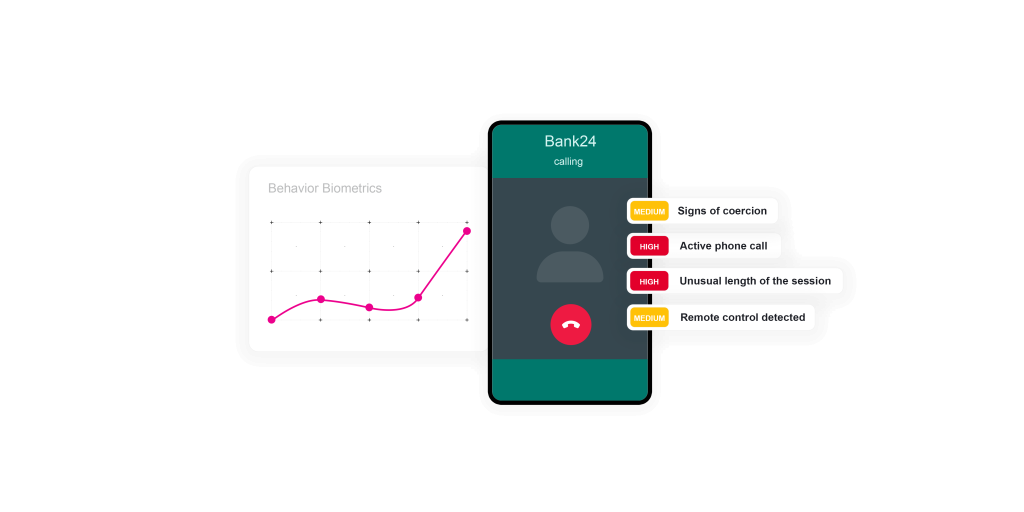
This is the advantage of looking for what the deepfake causes, rather than chasing the deepfake itself. Whether the customer was persuaded by a cloned voice, a synthetic video, or a highly convincing human scammer, the bank can look for the same kinds of signals once the deception turns into action.
Sometimes there is no compromised identity to detect. The customer is genuine, the authentication is successful, and the payment is intentional. What’s compromised is the decision behind it. That’s why the context surrounding the banking session matters so much in deepfake social engineering and other scams.
Learn more about behavioral intelligence
Where Deepfakes Really Change the Game
But there is one area where deepfakes genuinely change the equation—and make things considerably more difficult for fraud teams.
The catch is that detecting fraud doesn’t necessarily mean stopping it. The bank still has to convince the customer that what they believe is happening isn’t actually happening. With deepfakes, that can become a much harder argument to win.
Deepfakes don’t just look or sound convincing. They actually shape what we believe even after the deception is exposed. A series of three experiments published in Communications Psychology found that people continued to rely on information from deepfake videos in later judgments despite warnings that the videos were fake.
For banks, this could fundamentally change the intervention challenge. Convincing a manipulated customer is difficult enough. Convincing someone who has seen the person with their own eyes or heard their voice, and still believes that experience was real, is another level entirely.
When Detection Isn’t the End of the Story
The real challenge is helping a customer understand why the bank believes they’re being manipulated. And if AI is making the scammer’s story more convincing, the bank needs a stronger counter-case of its own.
This is where agentic fraud prevention capabilities may become increasingly important. Deepfake scams don’t just challenge a bank’s ability to detect fraud. They challenge its ability to explain it.
Behavioral intelligence can uncover the clues that something isn’t right: a sudden deviation from established behavior, an unusual transaction pattern, a high-risk beneficiary, or signs of external manipulation during a banking session.
Agentic capabilities can help fraud teams turn those signals into a clear, evidence-based case for intervention. Instead of a generic fraud warning, investigators get a structured explanation of what happened, what behavior is unusual, and why the situation resembles a known scam pattern.
That support becomes particularly valuable when customers are deeply invested in the scammer’s story. Whether the victim believes they’re helping a family member, speaking to their investment platform, or following instructions from their employer, effective intervention depends on giving them a stronger, more credible alternative explanation.
In the end, success against deepfake-enabled scams may come down not only to detecting them, but to how effectively banks can intervene once they do.
Talk to a fraud fighter
Related Articles
-
 April 14, 2026
Social Engineering Fraud: Detecting Manipulation Inside the Banking Session
It’s becoming increasingly difficult to find a fraud scheme that doesn’t involve some form of social engineering.
Let’s...
April 14, 2026
Social Engineering Fraud: Detecting Manipulation Inside the Banking Session
It’s becoming increasingly difficult to find a fraud scheme that doesn’t involve some form of social engineering.
Let’s...
-
 December 8, 2025
Smart Friction: How Adding the Right Kind of Friction Protects Users from Scams
In a fraud landscape dominated by social engineering and manipulation, a frictionless experience becomes a double-edged sword.
For more...
December 8, 2025
Smart Friction: How Adding the Right Kind of Friction Protects Users from Scams
In a fraud landscape dominated by social engineering and manipulation, a frictionless experience becomes a double-edged sword.
For more...
-
 October 8, 2025
Outside PSD3, Inside the Fraud Storm: Why Swiss Banks Should Rethink Scam Prevention
Switzerland occupies a curious space in Europe’s financial map.
It isn’t part of the EU and therefore sits...
October 8, 2025
Outside PSD3, Inside the Fraud Storm: Why Swiss Banks Should Rethink Scam Prevention
Switzerland occupies a curious space in Europe’s financial map.
It isn’t part of the EU and therefore sits...