

2026 Soccer World Cup Fraud: How to Spot Fraudsters Before They Score
The FIFA World Cup 2026 is likely to be the most watched and bet-on events of the year—and where attention and money are, fraud follows. What to expect, and how to give fraudsters a red card?
While the world’s attention will be focused on world-class soccer, financial institutions and betting companies will face a challenging task during the 2026 World Cup: safeguarding their customers as fraudsters try to blend in and take their slice of the cake.
And it is a big cake. The tournament in the United States, Mexico, and Canada is on track to break the all-time attendance record, with millions of on-site visitors and 6 billion viewers globally. Online betting will also be booming—about one in five football fans plans to place their first-ever bet during the tournament.
I used the official naming just here and then referred to it as “World Cup” or “Soccer World Cup”. I noticed other articles do this as well. I think it’s safer and less likely to draw attention from ambush marketing checks.
What Game Plan Should You Expect from Fraudsters?
The 2026 World Cup is set to draw strong new interest in markets like the USA and Canada, where soccer hasn’t traditionally been front and center.
For fraudsters, this creates a familiar opportunity: a large influx of users—many of them first-time or less experienced—engaging with ticketing platforms, travel offers, streaming sites, online betting, and other FIFA-related content.
Fraudsters will try to exploit this interest through two main strategies:
- Social engineering and scams
- Automated abuse at scale
Soccer World Cup Scams: How Fraudsters Exploit the Hype
As millions of fans travel to the three host countries, demand for tickets and accommodation surges, creating ideal conditions for scams. Ticketing and hospitality fraud are among the most common schemes, with fake websites selling non-existent tickets or packages and social media offers promoting seemingly attractive deals.
In both cases, the objective is the same: to make users score an own goal and authorize payments they are unlikely to recover.
“Too-good-to-be-true” tickets, hospitality deals, and other social engineering tactics, however, don’t just lead to authorized push payment (APP) fraud—they’re also part of broader attack chains. They’re frequently used as entry points for credential theft, often through phishing pages and malware infections. These attacks redirect unsuspecting users to malicious sites designed to steal data or compromise their devices.
With AI now a standard tool in the fraudster’s toolkit, these scams are becoming increasingly convincing. Fraudulent pages can replicate official FIFA branding, logos, and design with near-perfect accuracy, while AI-generated emails and voice messages further reinforce their credibility.
Why Scams Persist Despite Awareness Campaigns
While awareness campaigns (such as informing users to always use official channels) are important, scammers have an upper hand: human psychology. The fear of missing out, a closing opportunity window, and rising prices… For most people, it’s easy to get caught up in an “exclusive limited-time offer.”
So how do you stop fraudsters before they score? Protecting your customers must happen at the right moment: right when they are being targeted. At that point, natural barriers, such as hesitation and doubt, still persist—and with them, an opportunity to intervene. The key is to help users regain critical thinking by verifying suspicious content before the manipulation escalates.
Most solutions fall short when it comes to stopping manipulation at the right moment—before it fully takes hold. ScamFlag addresses this gap by enabling users to upload suspicious content (such as ads, emails, or text messages) and receive a plain-language assessment of whether the content is fraudulent. It also provides clearly explained scam indicators designed to help users pause, reassess, and regain critical thinking before authorizing a transaction.
Especially during global events, this AI-powered solution embedded in a native banking app can help reduce operational strain on fraud and customer service teams while giving customers a practical way to verify suspicious offers, messages, and payment requests.
Automated Abuse
This global soccer event also creates a different kind of opportunity. One that doesn’t rely on deceiving victims, but on exploiting systems at scale: betting abuse.
About 60% of global fans plan to bet during the 2026 World Cup, making it likely the most bet-on event in 2026. Betting companies will face a spike not only from their regular customers, but also from casual and first-time bettors—about 19% of football fans plan to place their first-ever online bet during the tournament.
This spike in activity and noise works in favor of cybercriminals. Coordinated groups (often involving money mules) can scale quickly, creating clusters of accounts tied to the same IP ranges, devices, or geographies, and operating as organized networks for targeted iGaming fraud.
These networks are then used to drive bonus abuse, multi-accounting, account takeovers, and payment manipulation.
The Investigation Bottleneck in Betting Abuse Detection
For iGaming and online betting companies, global events like the 2026 Soccer World Cup are a stress test of fraud prevention. The real bottleneck, however, often isn’t detection. It’s what comes after.
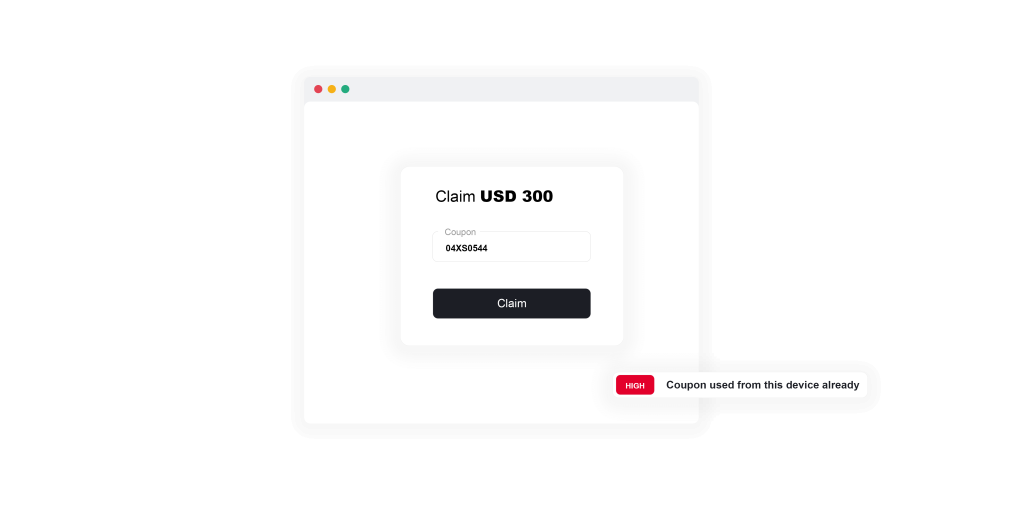
As activity spikes, fraud teams are flooded with alerts. Hundreds of detections can surface daily, many of them complex and interconnected. Each case requires manual effort, as analysts must piece together fragmented signals across sessions, devices, and accounts.
At the same time, coordinated networks, automated scripts, multi-account strategies, and dedicated betting bots allow fraudsters to scale their operations faster than fraud teams can realistically investigate—like a goalkeeper facing multiple players taking shots at once.
When Fraud Reaches Your Perimeter
The problem with these advanced fraud tactics is that they blend into normal activity. A manipulated user can look identical to a legitimate one. Coordinated networks can operate through accounts that appear clean. What reaches your system often looks valid. And especially during global events like the Soccer World Cup, precise detection without disrupting legitimate users is critical.
This is where behavioral intelligence becomes essential. Instead of relying only on transaction anomalies or static rules, it connects behavioral, device, threat, and transaction signals into a broader context.
- Behavioral signals: establish how users typically interact, navigate, and make decisions during a session
- Device intelligence: identifies links between accounts through shared devices, environments, or emulation
- Threat signals: reveal malware signatures, remote access tools, or known phishing links
- Transaction patterns: analyze timing, frequency, and relationships between transactions or bets
When connected, these signals can reliably uncover fraudulent patterns: a manipulated user, a coordinated network, or an automated bot no longer looks like normal activity.
The operational impact is significant. After implementing behavioral intelligence, Tipsport significantly improved detection of account takeover and bonus abuse scenarios, while Mean Time to Detect (MTTD) dropped by nearly 98%.
What High-Volume Events Reveal About Fraud Detection
During events like the 2026 World Cup, fraud teams face a tough balancing act. They need to stop increasingly sophisticated fraud without slowing legitimate users or overwhelming internal operations. And during high-volume events, the margin for error becomes very thin.
This is where behavioral intelligence makes a difference. By connecting behavioral, device, threat, and transaction signals into a broader context, fraud teams gain a clearer understanding of what is actually happening behind the transaction.
The impact goes beyond detection itself. Investigations become faster, false positives drop, and teams can respond with greater confidence even during periods of peak traffic and elevated fraud pressure.
Together with tools like ScamFlag helping users verify suspicious content before the manipulation fully takes hold, this creates a more proactive approach to fraud disruption—one that focuses not only on reliably detecting fraudulent transactions, but also on identifying threats earlier across the wider attack lifecycle.
During high-profile events where scams, account abuse, and automated fraud surge at the same time, that broader context becomes critical.
Talk to a fraud fighter
Related Articles
-
 August 4, 2026
KYT: Why Knowing Your Transaction Matters in the Era of Real-Time Payments
As scams rise and stolen money moves instantly, Know Your Transaction (KYT) is evolving from a compliance necessity...
August 4, 2026
KYT: Why Knowing Your Transaction Matters in the Era of Real-Time Payments
As scams rise and stolen money moves instantly, Know Your Transaction (KYT) is evolving from a compliance necessity...
-
 July 16, 2026
Understanding the Adversaries: How Fraudsters Really Operate
Today's fraudsters operate like businesses: organized, profit-driven, and constantly adapting. Here's what that means for your fraud strategy.
To...
July 16, 2026
Understanding the Adversaries: How Fraudsters Really Operate
Today's fraudsters operate like businesses: organized, profit-driven, and constantly adapting. Here's what that means for your fraud strategy.
To...
-
 July 13, 2026
The Hidden Cost of Fraud
The debate around rising fraud losses keeps circling the same numbers: how much was lost, how much was...
July 13, 2026
The Hidden Cost of Fraud
The debate around rising fraud losses keeps circling the same numbers: how much was lost, how much was...