

The Impact of Crypto Scams on Banks and How to Respond
From the “Trump Crypto Scam” aired during the 2026 Super Bowl to billions of dollars in reported losses, cryptocurrency has become a major vehicle for online fraud—and banks have an important role to play in stopping it.
Crypto Scams: the Costliest Scams
A staggering $17 billion was stolen globally through crypto scams and fraud in 2025, according to Chainalysis. In the United States alone, the FBI reported more than $11.3 billion in losses tied to cryptocurrency-related complaints, with crypto scams achieving the highest reported losses across all fraud categories.
Crypto investment fraud was the single costliest fraud category for Americans in 2025. Scammers clearly have a new favorite payment method: 72% of all investment scams involved cryptocurrency transactions.
But crypto isn’t limited to fake investment platforms. It has also become a dominant payment method in tech support scams and government impersonation scams. Even romance and confidence scams increasingly rely on crypto, with one in four cases involving cryptocurrency transfers.
The real cost of crypto scams, however, goes far beyond financial losses. Some victims lose savings intended for critical medical treatment. Others contemplate self-harm after realizing they had been deceived.
Why Crypto Scams Are Rising
The rising prevalence of crypto scams is impossible to ignore. But why are these schemes so successful? The answer is simple. Most crypto scams still rely on the oldest trick in the book: exploiting human psychology.
Take crypto investment scams and the tactics behind them:
- Authority bias (“We are experts. We know what others don’t.”)
- Social proof (“Everyone else is already profiting.”)
- Fake urgency (“Limited-time opportunity.”)
- Scarcity and exclusivity appeal (“Crypto is complicated—but you’re smart enough to get in early.”)
And then there’s the technical side:
- Social engineering tactics challenges traditional controls because victims authorize the payment themselves.
- Crypto scam recovery is extremely difficult. Once funds are converted into cryptocurrency, they can move rapidly across wallets, exchanges, and laundering networks.
- Crypto enables fraudsters to operate across borders with ease.
- AI makes scams more convincing and more scalable. From deepfakes and professionally generated websites to AI bots that target and engage victims automatically.
In short, crypto scams are a case study in today’s fraud: complex, AI-enabled, and engineered to cause maximum damage. They combine multiple tactics, sophisticated laundering networks, and increasingly, links to human trafficking and industrial-scale scam compounds.
Common Crypto Scam Types
Investment Scams
Investment scams are among the most common types of crypto fraud. Victims are usually approached through online ads, social media, WhatsApp groups, phone calls, or fake investment communities and presented with a “unique” opportunity.
The scammer instructs them to open an account at a legitimate cryptocurrency exchange, transfer money from their bank account, convert it into cryptocurrency, and deposit the funds into a fake investment platform controlled by the fraudsters.
At first, everything appears legitimate. The platform shows impressive profits and growing returns, encouraging the victim to invest more. But once they attempt to withdraw their money, the problems begin: frozen accounts, unexpected fees, tax requests, or endless verification steps. By then, the funds have often already been moved through laundering networks into criminally controlled wallets far beyond the victim’s reach.
Pig Butchering Scams
In pig butchering scams, fraudsters spend days, weeks, or even months building what appears to be a genuine relationship with the victim—often romantic in nature—before introducing the “investment opportunity.” By the time money enters the conversation, trust has already been established.
The emotional manipulation allows scammers to extract significantly larger amounts of money before the deception is uncovered. As a result, pig butchering scams, particularly those involving crypto, are among the most devastating forms of fraud both financially and psychologically.
Impersonation Scams
In impersonation scams, fraudsters pose as representatives of trusted organizations such as government agencies, banks, law enforcement, or cryptocurrency exchanges. They contact victims under a false pretense (a compromised account, suspicious activity, unpaid debt, or an urgent “security issue”) and pressure them into making a payment in cryptocurrency.
Crypto ATM Scams
Some crypto scams take victims out of digital banking channels entirely. Instead of requesting a transfer through online banking, fraudsters instruct victims to visit a crypto or Bitcoin ATM, deposit cash, convert it into cryptocurrency, and send it directly to a wallet controlled by the scammer.
Crypto ATM scams are notoriously difficult to intercept because they shift the critical transaction outside the online banking channel. In 2025 alone, Americans lost more than $333 million to these scams.
Fake Celebrity Endorsements
Crypto scammers sometimes pose, or falsely claim endorsements from, celebrities, businesspeople, or influencers to capture the attention of potential victims.
For example, during the 2026 Super Bowl, one of the largest AI-powered crypto scams ever appeared during a live sporting event. The “Trump Crypto Scam” used a synthetic version of Donald Trump across YouTube and social media to direct viewers to a fraudulent website and persuade them to send cryptocurrency with the promise to “double your money.”
Crypto Job Scams
Cryptocurrency job scams typically begin with fake work-from-home opportunities. Victims are promised salary payments or commissions for completing simple online tasks, but are required to deposit their own money into a platform to continue working.
At first, small withdrawals may be allowed to create a sense of legitimacy. Over time, however, deposit demands increase until the victim’s funds are locked, the account is frozen, and the scammers disappear with the money.
Extortion Crypto Scams
In extortion scams, fraudsters send alarming emails claiming they possess compromising information about the victim, alleging they recorded visits to adult websites or gained access to private files, passwords, or webcam footage. They then demand payment in cryptocurrency, threatening to expose the information unless the victim complies. In many cases, the claims are entirely fabricated.
Recovery Scams and Repeat Victimization
No matter the initial tactic, another common feature of crypto scams is repeated victimization.
After losing money, many victims are contacted again by fraudsters running so-called recovery scams. These scammers impersonate law enforcement agencies, private investigation firms, lawyers, or crypto companies and promise to help recover the stolen funds—for a fee, of course!
In pig butchering scams specifically, the FBI reports that almost all victims are later targeted by recovery scams.
Why Crypto Scams Are Difficult to Detect
At some point in their lifecycle, crypto scams intersect with the banking system—for example when victims transfer funds to cryptocurrency exchanges, or later become targets of recovery scams.
The challenge is that most traditional fraud systems were built to detect unauthorized activity: stolen credentials, account takeover, suspicious logins, or abnormal transactions.
Crypto scams, however, often look completely legitimate on the surface. The payment is:
- initiated by a real customer
- authenticated correctly
- sent from a trusted device
As a result, the warning signs are often behavioral rather than technical. Traditional tools simply weren’t designed to detect manipulation in time.
Additionally, crypto scams are no longer based purely on manipulation. Some fraud operations now combine social engineering with malware such as stealer malware or Remote Access Trojans (RATs), allowing scammers to compromise accounts or drain funds with minimal interaction. In these cases, device-level detection becomes critical because a single click may be enough.
Once funds move, they are quickly fragmented across wallets, transferred internationally, or laundered through exchanges and mule networks. That creates a major challenge for fraud teams because the detection window in crypto scams closes incredibly fast.
How Banks Can Respond Effectively
The complex nature of crypto scams demands equally sophisticated prevention strategies that address the entire scam lifecycle and the many forms these attacks can take, from seemingly authorized transactions to malware-driven account compromise.
1. Give customers tools, not advice
To protect customers from crypto scams, warning them about “too good to be true” schemes isn’t enough. What makes these scams especially dangerous is how convincing they have become. For most customers, the line between a legitimate investment platform and a high-fidelity imposter is increasingly difficult to spot.
Deploying tools that help customers recognize when they’re being targeted by scams, uncover manipulation techniques, and learn from the encounter is one of the most effective ways to prevent crypto scams.
2. Detect authorized fraud
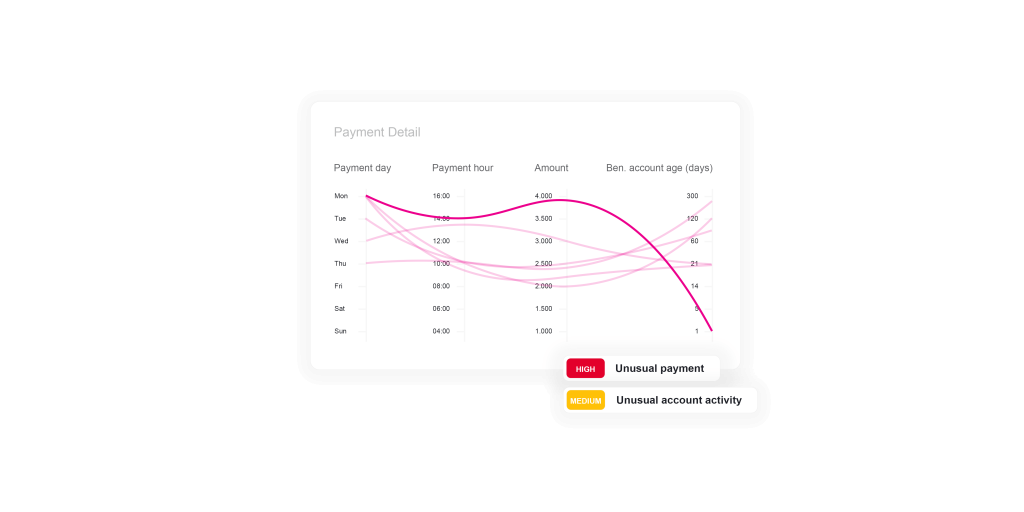
Detecting when something is wrong. Detecting when the transaction is initiated by a legitimate customer from a known device is one of the few ways to stop crypto scams in time. This requires fraud detection systems that analyze a broad range of signals: not just transactional data, but also behavioral, device, and threat intelligence signals.
Only by analyzing these signals together and in context can authorized fraud be detected reliably without dramatically increasing false positives.
3. Intervene before funds disappear
In crypto scams, timing matters. Once funds are converted into cryptocurrency and moved across wallets or exchanges, recovery becomes significantly more difficult. Detecting manipulation, suspicious behavioral patterns, or device compromise before the transaction is completed is often the only realistic chance to stop the fraud in time.
This is where real-time intelligence becomes critical. By analyzing user behavior, session context, device signals, and signs of social engineering in real time, high-risk situations can be identified early enough to intervene before funds leave the banking system.
Why Crypto Scams Remain a Banking Problem
Although crypto scams often leave the banking system quickly, their impact doesn’t.
Customers still:
- use bank accounts to fund crypto purchases
- initiate transfers from online banking
- contact the bank after losses occur
- expect intervention and support
- blame the bank when scams aren’t stopped
As a result, crypto scams can drive operational costs, increase reputational risk, and contribute to liability disputes. In an environment where recovery is uncertain and customer expectations continue to rise, the ability to identify scams before funds disappear is becoming a competitive necessity and a critical component of long-term fraud resilience.
Related Articles
-
 July 23, 2025
Key Strategies for AI Fraud Detection in Banking
Explore insights from our latest whitepaper on artificial intelligence (AI) and fraud, and learn how to make AI...
July 23, 2025
Key Strategies for AI Fraud Detection in Banking
Explore insights from our latest whitepaper on artificial intelligence (AI) and fraud, and learn how to make AI...
-
 February 11, 2025
The Dark Side of AI: How Fraudsters Are Using Artificial Intelligence to Scam at Scale
If any topic dominates cybersecurity in 2025, it will be artificial intelligence. How is AI helping fraudsters carry...
February 11, 2025
The Dark Side of AI: How Fraudsters Are Using Artificial Intelligence to Scam at Scale
If any topic dominates cybersecurity in 2025, it will be artificial intelligence. How is AI helping fraudsters carry...
-
 January 24, 2025
How AI is Redefining Fraud Prevention in 2025
The year 2024 has shown us that artificial intelligence is here to change the world of fraud. Both...
January 24, 2025
How AI is Redefining Fraud Prevention in 2025
The year 2024 has shown us that artificial intelligence is here to change the world of fraud. Both...